
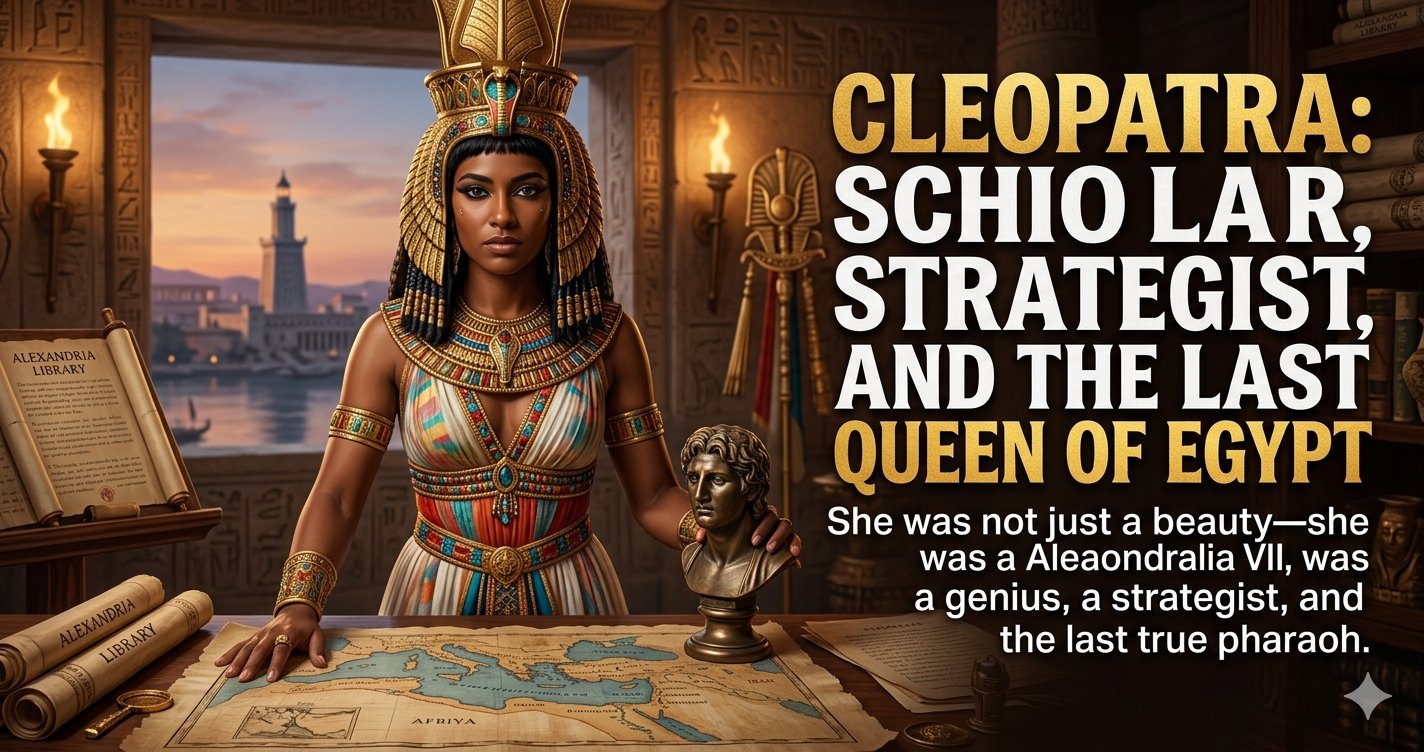
Cleopatra: Scholar, Strategist, and the Last Queen of Egypt
She was not just a beauty—she was a genius, a strategist, and the last true pharaoh.
👑 When people hear the name Cleopatra, they often imagine romance, luxury, and political drama. Yet Cleopatra was far more than a legendary beauty or a tragic lover. She was one of the most educated and politically astute rulers of the ancient world — a multilingual scholar, a strategist, and the last active ruler of Ptolemaic Egypt.
A Queen Unlike Her Dynasty
Cleopatra ascended the throne at just 17 and ruled during one of the most turbulent periods in Mediterranean history. Unlike many members of the Ptolemaic dynasty — who were of Macedonian Greek origin and rarely embraced Egyptian culture — Cleopatra learned to speak Egyptian and could read hieroglyphics. This was highly unusual for her lineage.
Ancient sources suggest she spoke multiple languages, including Greek and the languages of neighboring regions such as the Parthians, Hebrews, Medes, Syrians, Ethiopians, and Arabs. Her linguistic ability was not ornamental; it was political. It enabled her to negotiate directly with foreign envoys without translators — a powerful diplomatic advantage.
Cleopatra the Intellectual
📚 Cleopatra's interests extended far beyond governance. She studied geography, history, astronomy, mathematics, medicine, alchemy, economics, and international diplomacy. Ancient writers describe her as intellectually curious and deeply engaged with the sciences of her time.
She is believed to have written treatises on herbal medicine and cosmetics. Although none of her works survive, later references suggest they circulated in antiquity. The famed Greek physician Galen reportedly cited medicinal preparations attributed to her, including remedies related to dermatology and hair treatment.
in the destruction of the Library of Alexandria —
a loss that history still mourns.
The Political Strategist
Cleopatra's reign unfolded against the rising power of Rome. Her alliances were not romantic accidents — they were calculated political strategies.
Alliance with Julius Caesar (48 BCE)
Amid a civil war with her brother Ptolemy XIII, Cleopatra sought support from Julius Caesar. According to Plutarch, she famously arranged to be smuggled into Caesar's quarters wrapped in bedding or a carpet. Caesar backed her claim to the throne, restoring her authority. Their alliance strengthened her position and produced a son, Caesarion. For Cleopatra, this partnership was about preserving Egypt's sovereignty in the face of Roman expansion.
Partnership with Mark Antony
After Caesar's assassination, Cleopatra formed a new alliance with Mark Antony. Their meeting in Tarsus became legendary — Cleopatra reportedly arrived on a grand barge styled as the goddess Isis, blending political theater with symbolism. Together they ruled eastern territories and had three children. However, their growing power alarmed Rome, particularly Octavian, who would later become Augustus.
The Fall: Battle of Actium (31 BCE)
The fate of Egypt was decided at the Battle of Actium. Octavian's forces defeated the fleet of Antony and Cleopatra. The loss marked the collapse of their military power. A year later, as Roman forces advanced into Alexandria, Antony took his own life. Cleopatra, refusing to be paraded in a Roman triumph, also ended her life in 30 BCE. The traditional story claims she died from the bite of an asp, though historians debate this account.
Her death marked the end of the Ptolemaic dynasty and the transformation of Egypt into a Roman province.
Cleopatra in Literature and Modern Culture
🎭 Cleopatra's life has inspired writers, dramatists, and filmmakers for centuries.
William Shakespeare immortalized her in Antony and Cleopatra, portraying her as passionate, charismatic, and tragic. In cinema, the epic film Cleopatra, starring Elizabeth Taylor, cemented her image as a glamorous icon.
🎬 Yet these portrayals often emphasize romance over statecraft, overshadowing her administrative competence and diplomatic intelligence.
Beyond Myth and Legend
🏛️ Roman propaganda, particularly under Augustus, portrayed Cleopatra as a seductive foreign threat. Modern scholarship, however, presents a more nuanced portrait: a ruler navigating immense geopolitical pressure, using intellect, language, diplomacy, and symbolism to defend her kingdom.
She was not merely the lover of powerful men; she was a monarch operating within the harsh realities of imperial politics.
A Legacy That Endures
💎 Cleopatra remains one of history's most compelling figures — not only for her dramatic alliances and tragic end, but for her intellectual ambition and political acumen. She was a scholar-queen in an age of empires, striving to preserve Egypt's independence at the edge of Roman domination.
👑 Her legacy endures because she was not one-dimensional. She was a linguist, strategist, scientist, diplomat, and ruler — a rare combination that continues to fascinate historians and readers alike.
But only the curious discover who she truly was. ✨




0 Comments
Share your feedback.