
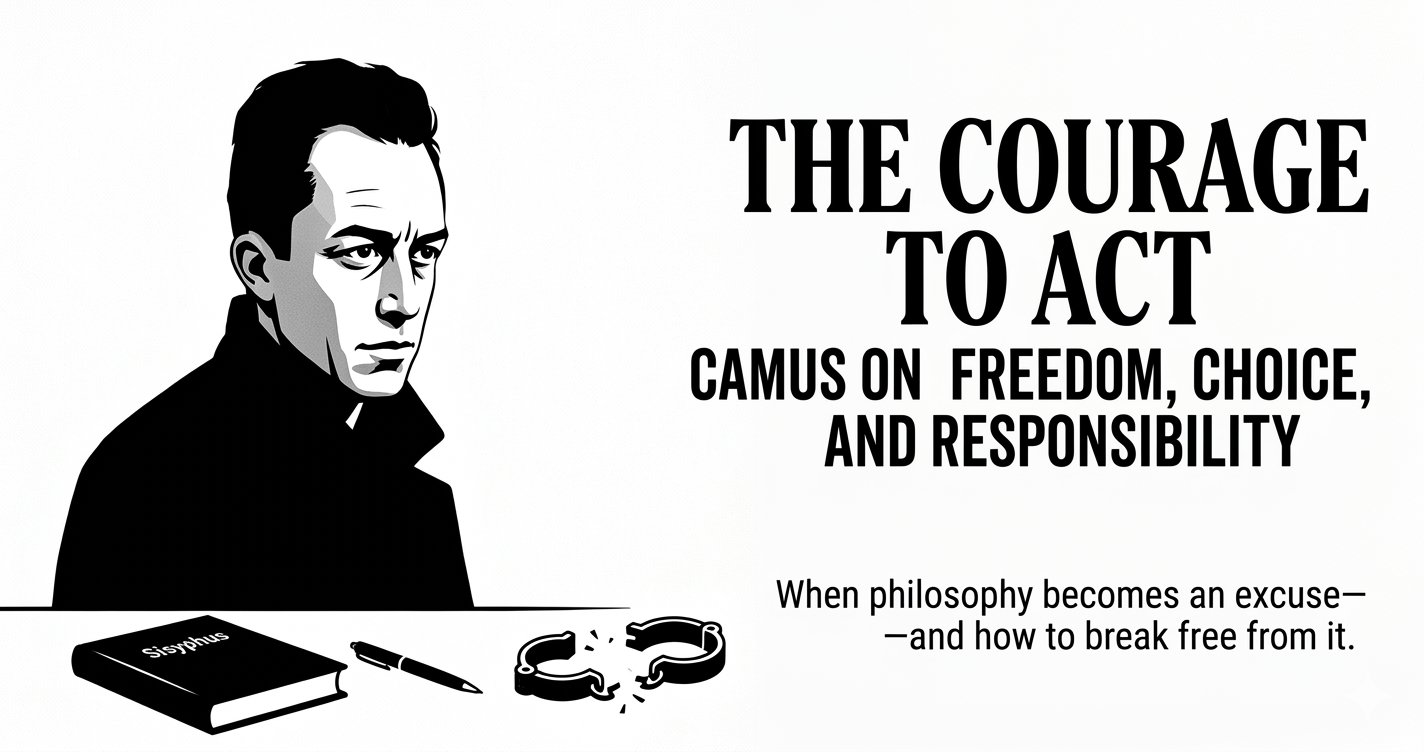
The Courage to Act: Camus on Freedom, Choice, and Responsibility
When philosophy becomes an excuse—and how to break free from it.
This is more than a sharp observation—it is a diagnosis of a deeply human habit. When faced with difficult decisions, uncertainty, or moral risk, we often look for ideas that allow us not to act. Albert Camus, through his engagement with existentialism and absurdism, repeatedly returned to this tendency: the quiet ways in which people evade responsibility while believing they are being intellectually honest.
The Comfort of Withdrawal
🎭 Camus was less interested in abstract theory than in how ideas shape lived behavior. He observed that when courage falters, individuals often gravitate toward belief systems that legitimize withdrawal. These philosophies do not merely explain the world; they absolve the individual from the burden of choice. In doing so, they offer comfort—at the cost of freedom.
When Determinism Becomes a Shelter
🛡️ Rather than confronting fear, ambiguity, or moral complexity head-on, many seek refuge in worldviews that render action meaningless or unnecessary. Determinism, for instance, can become a convenient shelter. If everything is already decided—by fate, history, or structure—then personal responsibility dissolves. Effort appears futile, and passivity becomes defensible.
often masks an unwillingness to act.
The Tension of the Absurd
🌀 Camus understood this move as a form of intellectual escapism. It protects the individual from anxiety, but it also distances them from reality. The absurd, as Camus defined it, is not something to be explained away or neutralized by theory. It is the tension between our desire for meaning and the world's indifference. To deny this tension through comforting philosophies is, in Camus' view, a failure of honesty.
💭 His response was not despair, but responsibility.
Freedom Without Escape
✨ Camus insisted that even in an absurd universe—especially in such a universe—human beings remain free. And with freedom comes accountability. We cannot escape the weight of our choices by hiding behind systems of thought that deny agency. To live authentically is to accept uncertainty without surrendering action.
The Courage to Act
⚡ Ultimately, Camus' challenge is ethical rather than theoretical. He calls on us to recognize when philosophy becomes an excuse, when ideas serve as shields against courage. Meaning, he suggests, is not discovered through retreat or rationalization. It is forged through conscious, courageous engagement with life—through choosing to act, despite the absence of guarantees, in a world that offers none.
🌊 You are here to create it.
🌊 Act. Choose. Rise.




0 Comments
Share your feedback.